

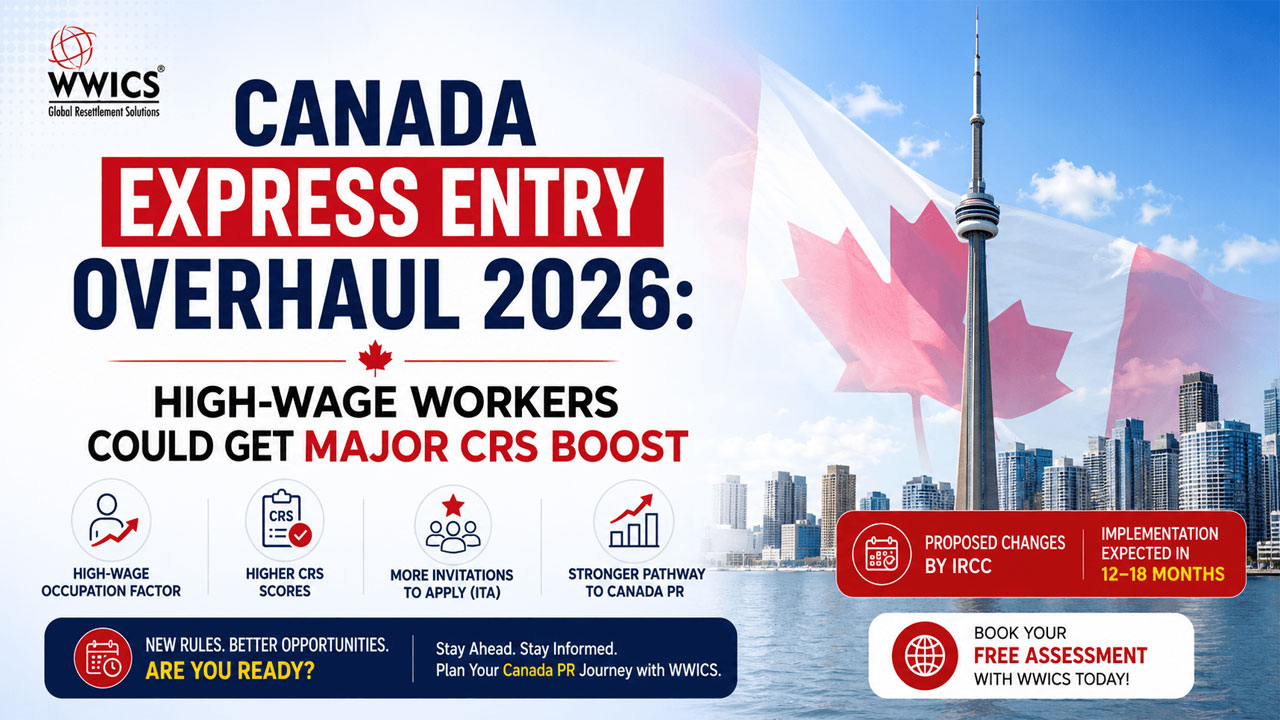
Canada is preparing for one of the biggest changes to its immigration system in years. Under the proposed Express Entry overhaul 2026, high-wage workers could soon receive a major advantage in the Comprehensive Ranking System (CRS), significantly improving their chances of getting permanent residency in Canada.
According to recent updates from Immigration, Refugees and Citizenship Canada (IRCC), a new high-wage occupation factor may soon become part of the Express Entry system. This proposed change is expected to prioritize skilled professionals working in occupations that earn above Canada’s national median wage.
For thousands of professionals planning to apply for Canada PR, especially IT professionals, engineers, healthcare workers, and senior executives, these Canada Express Entry changes could create exciting new opportunities.
What Is Canada’s Express Entry System?
Express Entry is Canada’s primary immigration system for skilled workers applying for permanent residency. It manages applications under:
- Federal Skilled Worker Program (FSW)
- Canadian Experience Class (CEC)
- Federal Skilled Trades Program (FST)
Candidates in the Express Entry pool are ranked using the Comprehensive Ranking System (CRS), which awards points based on factors such as:
- Age
- Education
- IELTS or TEF scores
- Work experience
- Canadian employment
- Adaptability factors
IRCC regularly conducts Express Entry draws and invites the highest-ranking candidates to apply for Canada PR.
Over the years, the CRS system has evolved multiple times, but the proposed Express Entry new rules for 2026 could be among the most impactful reforms since the system launched in 2015.
The 2026 Express Entry Overhaul: What Is IRCC Proposing?
As part of the latest Canada immigration news 2026, IRCC has proposed introducing a new High-Wage Occupation factor into the CRS scoring system.
This means candidates working in occupations that are considered “high wage” under Canada’s labour market data could receive additional CRS points.
The goal behind this reform is simple: Canada wants to attract and retain skilled workers in occupations facing major labour shortages while strengthening the country’s economy.
Public consultations on the changes recently concluded, and immigration experts expect implementation within the next 12 to 18 months. However, some reports suggest the high-wage factor itself could arrive much sooner.
This is why many immigration professionals are calling the proposed reform one of the most important Express Entry updates 2026.
What Is the High-Wage Occupation Factor?
The proposed high-wage occupation factor IRCC plans to introduce would award extra CRS points to candidates who:
- Have Canadian work experience in a qualifying occupation, or
- Hold a valid Canadian job offer in a high-paying occupation
Importantly, the system would not be based on an individual’s salary alone. Instead, IRCC would assess occupations using Canada’s Job Bank wage data and National Occupational Classification (NOC) codes.
This means the occupation itself would determine whether a candidate qualifies for additional CRS points.
Proposed Wage Tiers
IRCC has discussed a possible three-tier structure:
| Wage Tier | Example Occupations | Expected CRS Benefit |
| Tier 1 – 2× national median wage | Physicians, senior executives, petroleum engineers | Highest CRS boost |
| Tier 2 – 1.5× national median wage | Software engineers, registered nurses, civil engineers | Moderate CRS boost |
| Tier 3 – 1.3× national median wage | Financial analysts, skilled trades supervisors | Base CRS boost |
Although exact CRS points have not yet been announced, immigration experts believe this new factor could significantly reshape the Express Entry pool.
How Express Entry Overhaul Affects Skilled Workers
The proposed Express Entry system changes are especially important for high-demand professionals from India.
Professionals in Punjab, Delhi NCR, Bengaluru, Hyderabad, Chandigarh, and other major cities who work in high-paying occupations may soon benefit from improved CRS rankings.
IT and Software Professionals
Canada continues to face strong demand for software engineers, developers, data analysts, cybersecurity specialists, and AI professionals.
Under the proposed reforms, many of these occupations could fall into Tier 2 or Tier 1 categories. This could create major opportunities for candidates seeking Canada PR for IT professionals India.
Engineers
Mechanical engineers, civil engineers, petroleum engineers, and electrical engineers are also expected to benefit.
Many engineering occupations consistently earn above Canada’s national median wage, making them strong candidates for the new high-wage occupation factor.
This could improve Canada PR for engineers significantly under the new Express Entry rules.
Healthcare Professionals
Canada’s healthcare sector continues to experience severe labour shortages.
Doctors, registered nurses, physiotherapists, and healthcare specialists are expected to benefit heavily from the proposed changes. Some healthcare occupations may even qualify for the highest CRS boost.
Senior Managers and Executives
Senior corporate managers and executives could also gain a major advantage under the new system.
IRCC has already indicated that certain executive-level occupations may fall under the highest wage category.
CRS Score Changes: What Could Happen to Your Profile?
One of the most important things candidates should understand is that IRCC usually recalculates CRS scores automatically whenever major Express Entry changes are introduced.
This means if your occupation qualifies under the new high-wage system, your CRS score may increase automatically once the new rules become active.
What You Should Do Right Now
To prepare for the latest Express Entry reform impact on CRS score, candidates should:
- Verify their NOC code carefully
- Check median wage data for their occupation
- Improve IELTS or TEF scores wherever possible
- Explore Provincial Nominee Program (PNP) pathways
- Keep Express Entry profiles updated
Candidates should also monitor ongoing Express Entry draw updates 2026 closely.
What About Lower-Wage Occupations?
The proposed changes do not eliminate opportunities for candidates in lower-wage occupations.
Skilled workers will still be eligible under Express Entry based on:
- Education
- Language proficiency
- Canadian work experience
- Adaptability
- Provincial nominations
However, competition may become tougher if high-wage occupations receive substantial CRS boosts.
For candidates who may not benefit from the new wage factor, Provincial Nominee Programs (PNPs) could become even more important. PNPs can add 600 CRS points and almost guarantee an Invitation to Apply (ITA).
Industries Most Likely to Benefit From the New Rules
Several sectors are expected to gain the most from the proposed reforms:
Technology and IT
Canada’s technology sector continues expanding rapidly. Demand remains high for:
- Software developers
- Cloud engineers
- AI specialists
- Cybersecurity professionals
- Data scientists
This is why many experts believe Canada immigration for IT professionals will remain a major focus under Express Entry 2026.
Healthcare
Healthcare occupations are expected to remain among Canada’s top immigration priorities.
Engineering and Skilled Trades
Engineering and construction sectors continue facing shortages across several provinces.
Finance and Business
Financial analysts, investment professionals, and senior management occupations may also benefit under the new CRS structure.
Expert Immigration Insights: What WWICS Recommends
At WWICS Immigration, we believe the proposed Express Entry overhaul 2026 represents a major opportunity for skilled professionals planning to settle in Canada.
The new high-wage occupation factor could create stronger pathways for candidates working in in-demand occupations.
Our recommendation is simple:
- Verify your NOC code immediately
- Assess your occupation’s wage category
- Improve your language scores
- Explore both Express Entry and PNP options
- Keep your profile updated for future CRS changes
With more than 32 years of experience and over 100,000 successful client cases, WWICS continues to help skilled professionals navigate evolving immigration policies successfully.
How WWICS Can Help You
As one of the world’s leading immigration groups, WWICS offers complete guidance for:
- Canada PR eligibility checks
- Express Entry profile creation
- CRS score optimisation
- NOC code verification
- IELTS guidance
- Provincial Nominee Program applications
- End-to-end PR support
Whether you are applying for Canada PR from India 2026, exploring Express Entry opportunities, or assessing your eligibility under the new high-wage occupation system, our experienced consultants can help you build the right immigration strategy.
Conclusion
The proposed Canada Express Entry changes for 2026 could significantly transform the immigration landscape for skilled professionals.
For candidates working in high-paying occupations, the new CRS factor may improve the chances of receiving an Invitation to Apply for permanent residency.
Key takeaways include:
- High-wage occupations may receive additional CRS points
- IT professionals, engineers, healthcare workers, and executives are likely to benefit most
- CRS scores may be recalculated automatically
- Provincial Nominee Programs remain important for other candidates
- Early preparation is critical
As IRCC continues finalising the reforms, now is the ideal time to assess your profile and prepare for the future of Canadian immigration.
If you are planning to apply for Canada PR, book your free Canada PR assessment with WWICS Immigration today and understand how the latest Express Entry updates for foreign workers 2026 could impact your profile.